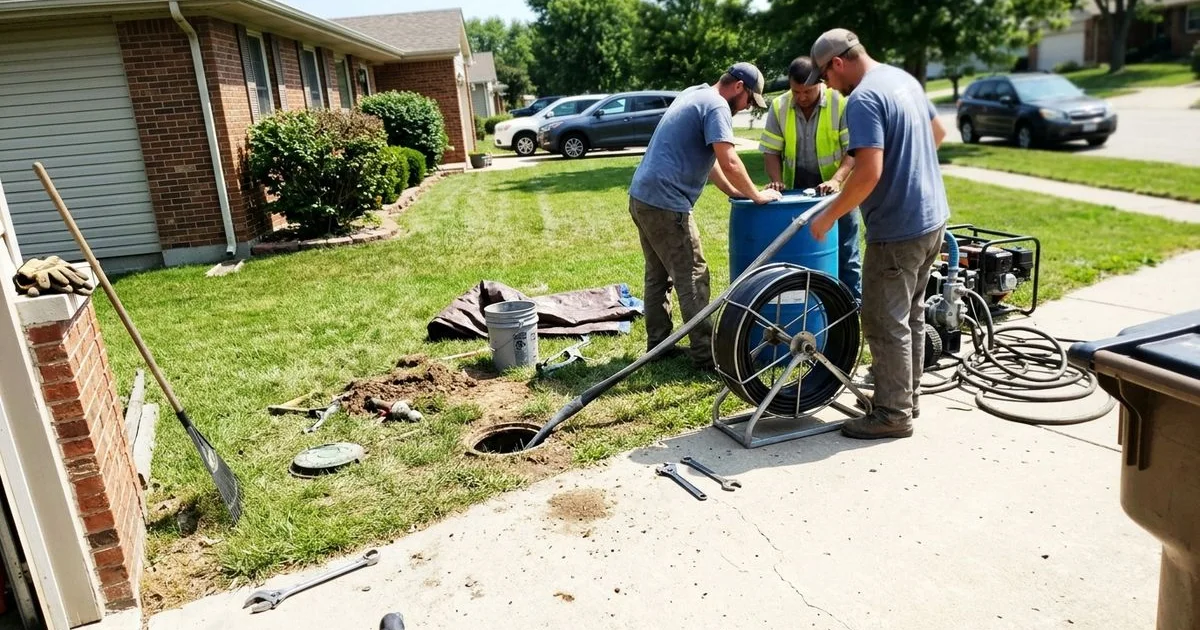
Once a camera shows real damage in a sewer line, clearing it again is no longer the answer. The next question is how to fix it: line the pipe in place, or dig it up and replace it. Both produce a working sewer. They differ in what they can fix, how much of your property gets torn up, and what the total project ends up costing.
Start with the one question that decides it
Is the pipe still in the right shape and position?
If it is cracked, leaking, or root-filled but still round and properly aligned, lining can work. If it has collapsed, sagged, or shifted out of line, it has to come out.
Everything below adds detail to that question.
How each method works
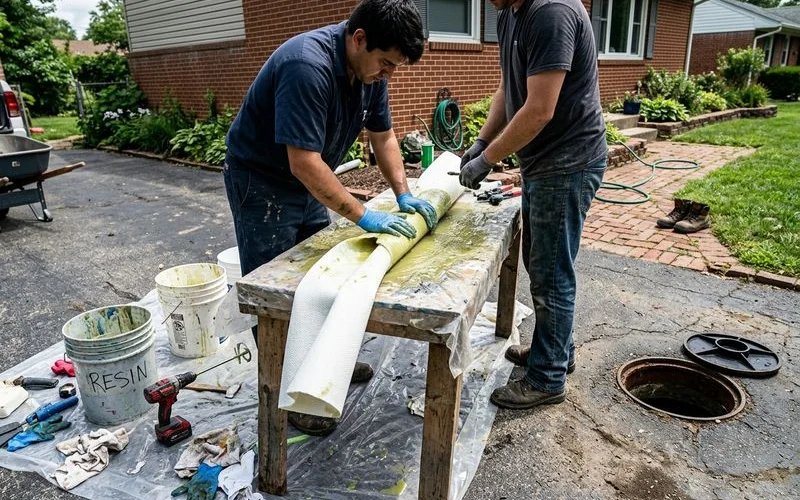
Trenchless lining (cured-in-place pipe). The line is cleaned, usually by jetting, so the liner can bond. A resin-soaked liner goes in through a cleanout or a small access pit and is inflated against the old pipe wall. It cures with hot water, steam, or UV light into a smooth, jointless pipe inside the old one. Many residential jobs finish in a day.
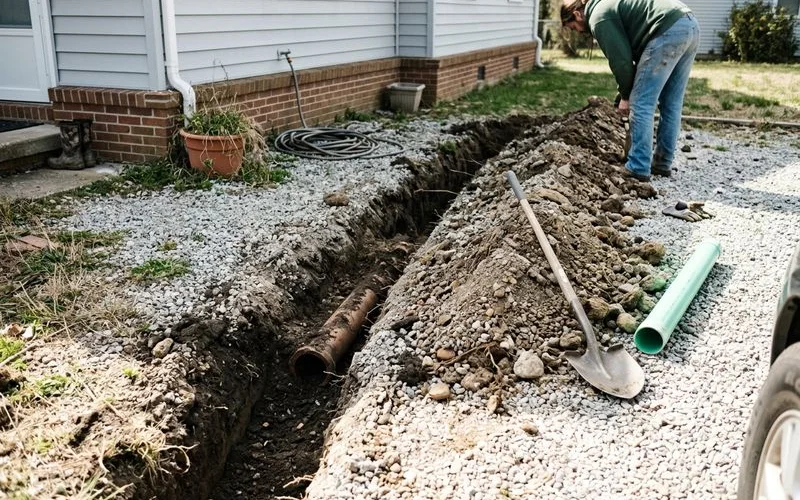
Dig-and-replace. A trench is opened along the failed section, the old pipe comes out, and new pipe is laid at the correct slope. The trench is backfilled and compacted, then the surface is restored. It is permanent and can correct any problem, but it is disruptive, and restoring concrete or landscaping adds time and cost.
What each can fix
| Problem found on camera | Lining | Dig-and-replace |
|---|---|---|
| Cracks and leaking joints | ✓ | ✓ |
| Root intrusion at joints | ✓ (seals the joints) | ✓ |
| Corroded but intact cast iron | ✓ | ✓ |
| Severe joint offset | Usually not | ✓ |
| Belly or sag holding water | No | ✓ |
| Collapsed or crushed section | No | ✓ |
| Wrong slope | No | ✓ |
Disruption and cost drivers
| Criteria | Lining | Dig-and-replace |
|---|---|---|
| Yard disruption | Access points only | Trench along the line |
| Driveway or patio over the line | Usually untouched | Cut and replaced |
| Typical timeline | Often one day | Several days including restoration |
| Cost per foot of pipe | Often higher | Often lower |
| Surface restoration cost | Minimal | Can be large |
| Tolerance of future minor soil movement | Jointless, flexible | Depends on new pipe; PVC is better than old clay |
The cheapest-looking option per foot is not always the cheapest project. Lines under concrete and mature landscaping tend to favor lining. Short runs under open dirt tend to favor digging.
Why Yuma laterals fail
Older homes in the original townsite and nearby central neighborhoods often still have clay or cast iron laterals. Clay joints let roots in from mature yard trees. Cast iron corrodes from the inside until the wall thins and cracks. Near irrigated land, repeated wetting and drying of the soil adds ground movement that pulls rigid joints apart and creates sags.
That background affects the choice. If soil movement broke the line once, it can stress it again. A jointless liner handles minor movement better than old clay, but no liner can fix a line the ground has already pushed out of position.
The hybrid option
Often only one stretch is badly damaged. Excavating and replacing that section, then lining the rest of a marginal run, can be the best value on an older lateral with one bad spot and general wear elsewhere.
Questions to ask before approving either
- Can I see the camera footage of the damaged section?
- Why this method, and why not the other one?
- Does the estimate include surface restoration: concrete, landscaping, irrigation?
- What warranty applies to the liner or new pipe, and who backs it?
- What condition are the sections not being repaired in?
- Is there a permit, and who pulls it?
If the inspection also turned up supply-side problems, our leak detection and slab leak repair page covers that work.
Getting the diagnosis right
The decision starts with good footage. Camera inspection is part of our drain cleaning and sewer diagnosis service. Call Yuma Plumbing Pros at any hour in English or Spanish, request a free estimate, and ask about any service call fee before booking. Repairing eight feet of a forty-foot line that is failing along its whole length fixes this year’s problem and sets up next year’s, so make sure the plan covers the whole line.