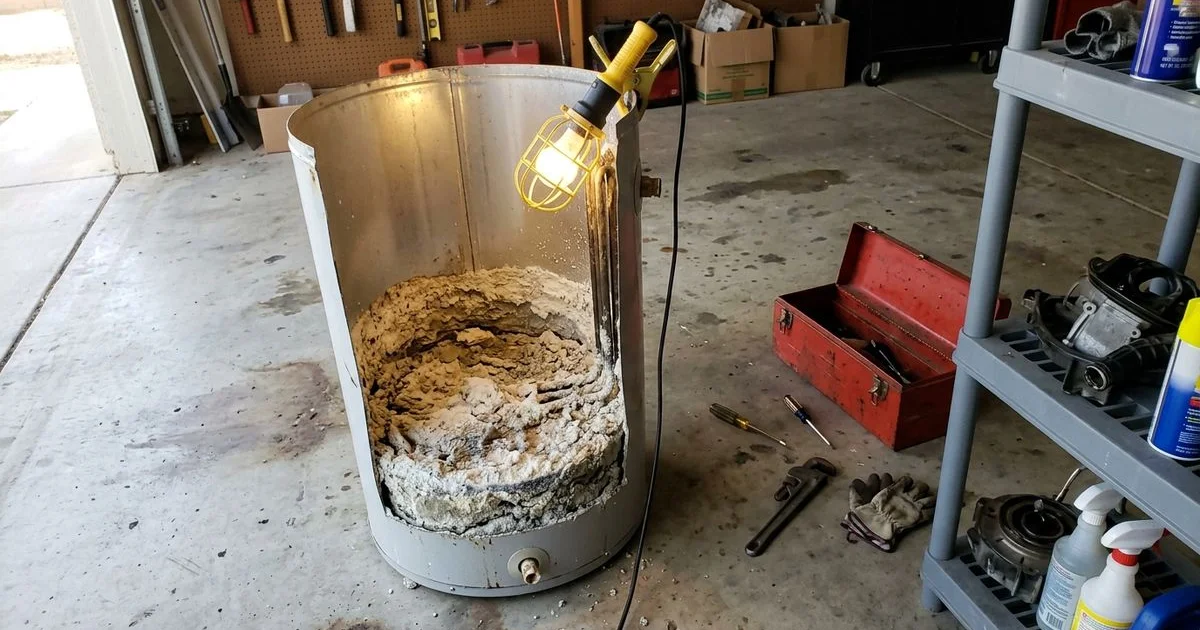
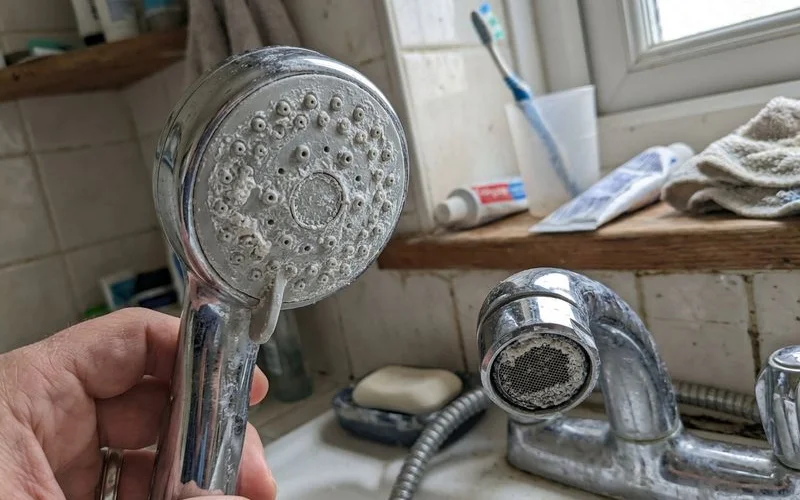
If you have lived here for more than a year, you have probably seen it already: white crust on the shower head, cloudy spots on glasses, a faucet handle that grinds. Those are the visible signs. The expensive part happens where you cannot see it, inside the water heater.
This guide explains what the hardness number means, where the scale ends up, and what you can realistically do about it.
The number, in plain terms
The City of Yuma treats water from the Colorado River and blends it with groundwater. The city’s guidance puts the result at 18 to 22 grains per gallon, which works out to roughly 310 to 380 milligrams per liter. Plumbers usually talk in grains per gallon (gpg); lab reports often use mg/L. To convert, divide mg/L by 17.1.
| Classification | Grains per gallon | mg/L |
|---|---|---|
| Soft | Under 1 | Under 17 |
| Slightly hard | 1 to 3.5 | 17 to 60 |
| Moderately hard | 3.5 to 7 | 60 to 120 |
| Hard | 7 to 10.5 | 120 to 180 |
| Very hard | Over 10.5 | Over 180 |
| Yuma city supply | 18 to 22 | about 310 to 380 |
So the city supply sits at roughly twice the very-hard line.
Not on city water?
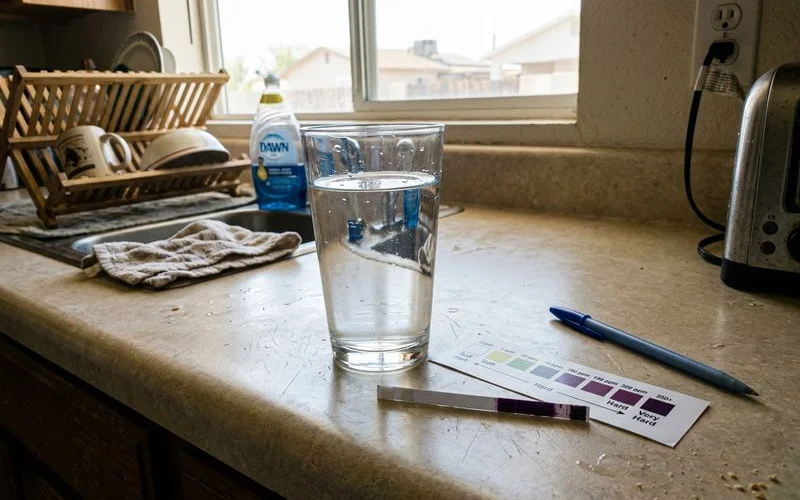
Homes in the Fortuna Foothills and other communities outside the city system are served by separate water systems that draw from groundwater. Their hardness can be different. A test strip or a quick test at your tap is the only reliable number for your house.
Where the minerals go
Hardness is dissolved calcium and magnesium. While the water is cold and moving, those minerals stay in solution. Two things force them out:
- Heat. Warm the water and the minerals come out as solid scale.
- Evaporation. Let water dry on a surface and the minerals stay behind.
That tells you exactly where to look: anything that heats water, and anything that gets wet and dries.
The damage, ranked by what it costs you
1. Water heaters. This is the big one. Every time the burner fires, minerals settle on the bottom of the tank and harden into a crust. That crust sits between the flame and the water. The burner runs longer, the steel above it runs hotter than designed, and the tank corrodes from the inside. This is the main reason heaters on this water fail years short of their rated life. Early signs are popping or rumbling during a heat cycle and running out of hot water sooner. Our water heater repair page covers what to do about it.
2. Tankless heat exchangers. These have the narrowest passages in the house and the hottest surfaces. Without descaling on a regular schedule, they lose efficiency, throw error codes, and fail early.
3. Valves. Angle stops and main shutoffs that sit unused for years seize as scale builds around the stem. You find out during a leak, when the valve will not turn.
4. Faucet cartridges and toilet parts. Ceramic discs, valve seats, flappers, and fill valves all depend on smooth surfaces that seal against each other. Scale wears them out early.
5. Appliances. Dishwasher and washing machine heating elements scale the same way a water heater does.
6. Shower heads and aerators. The most visible damage and the cheapest to fix, but a reliable sign that the rest is happening too.
Why the summer heat makes it worse
Summers here run past 110 degrees for long stretches, and the supply line stays warm for months. Warm water is already closer to the point where minerals drop out, so scale forms faster. Heaters in hot garages also cycle hard with no break.
What you can do, from least to most effective
| Step | What it does | What it does not do |
|---|---|---|
| Clean aerators and shower heads | Restores flow at that fixture | Nothing for the heater or valves |
| Flush the water heater yearly | Removes loose sediment before it hardens | Does not stop new scale |
| Check the anode rod every 2 to 3 years | Protects the tank from corrosion | Does not address scale |
| Descale tankless units on a schedule | Keeps the heat exchanger clear | Needs repeating |
| Salt-free conditioner | Reduces how much scale sticks | Does not remove hardness |
| Whole-home ion-exchange softener | Removes hardness before it reaches anything | Does not purify drinking water |
| Reverse osmosis at one tap | Better drinking and cooking water | Does not protect the rest of the house |
At this hardness, a properly sized softener is closer to preventive maintenance than an upgrade. Sizing matters: the city recommends setting softeners for 18 to 22 grains, and the unit’s capacity has to match your household’s daily use. Our page on water softeners and reverse osmosis explains how that calculation works.
The bottom line
The water in your pipes will not change, but how much damage it does depends on what you do about it. If you are seeing crust on fixtures or hearing your water heater pop, Yuma Plumbing Pros can take your call any hour, in English or Spanish, and send the details to a local plumber. Request a free estimate and ask about any service call fee before booking.